The Art of Looking Busy So Your Spouse Doesn't Give You Another Project
Professor Stone Oakley


 0 Recommendations
A retiree's scholarly guide to dodging the honey-do list, one strategic sigh at a time
55+ Living on Retirenet.com
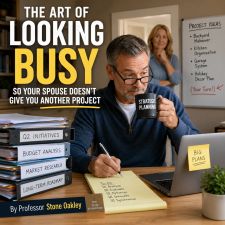
The Art of Looking Busy
So Your Spouse Doesn't
Give You Another Project
By Professor Stone Oakley, Chair of Applied Avoidance Studies
When you retired, you were sold a vision. Hammocks. Sunsets. A man at peace with his iced tea, watching a sprinkler do the only labor required of the household. What no one told you — what the brochures conveniently omitted between the photos of laughing couples on bicycles — is that your spouse retired too. And your spouse brought a list.
The List is not a document. A document has an ending. The List is a living organism, a self-replenishing scroll that grows a new task the instant you complete an old one. Hang the picture, and the picture reveals that the wall needs painting. Paint the wall, and the paint reveals that the baseboards are, and I quote, “a situation.” There is no bottom to the List. There is only the brief, shimmering illusion of a bottom, which exists solely to lure you into finishing one more thing.
The only defense, refined over decades of field research, is the appearance of productivity. Not productivity itself — that way lies more projects — but its convincing imitation. What follows is a survey of the discipline.
The Foundational Principle: Never Be Caught at Rest
A man sitting down is a man with capacity. This is the great vulnerability. The moment your spouse rounds the corner and finds you motionless in a chair, the neurons fire, and a project is assigned before you have fully exhaled. The trained retiree understands that the seated position must always be justified by an open laptop, a spread of paperwork, or — in advanced cases — a furrowed brow aimed at a wall, suggesting you are mentally rotating a load-bearing decision.
Rest is permitted. Rest that looks like rest is not.
The Garage: A Sovereign Nation
Let us speak plainly about the garage. The garage is not a room. It is a territory, a demilitarized zone into which the List cannot legally extend. Inside the garage, a man may stand before a workbench holding a single screwdriver for forty minutes and emerge unquestioned, even celebrated. “He’s working on something,” your spouse will say to a neighbor, with a note of pride. You are not working on something. You are achieving a state of monastic stillness that the rest of the house simply will not permit. The screwdriver is a prop. The garage is a cathedral.
The Clipboard Doctrine
Carry a clipboard and you are auditing. Carry a tool and you are repairing. Carry nothing and you are available, which is the most dangerous condition a retiree can enter. The clipboard, in particular, projects an aura of ongoing assessment so powerful that some practitioners report being asked, in hushed tones, “How’s it coming along?” — with no specification of what it is. You do not need to know what it is. You simply nod gravely and say, “Slower than I’d like.”
The Purposeful Walk
Velocity communicates intent. A man strolling has nowhere to be and will be redirected. A man walking briskly, with a slight lean forward and an item in hand — a wrench, a tape measure, a single battery — is clearly en route, and one does not interrupt a man en route. The destination is irrelevant. You may walk from the kitchen to the garage to the kitchen again in a loop for the better part of an afternoon. The lean is what sells it. Practice the lean.
“I’m Researching It”
For the larger items on the List — the ones that cannot be deflected by props alone — the scholar deploys the eternal stall: research. “I’m researching it” is the most beautiful sentence in the English language, because research has no deadline, no visible output, and no agreed-upon definition of completion. You may research a ceiling fan for eleven days. You may research the optimal mulch for the better part of a fiscal quarter. The act of opening four browser tabs about a gutter guard and reading none of them constitutes, legally and morally, “looking into it.” And looking into it is a verb that can be conjugated indefinitely.
The Strategic Sigh
When confrontation is unavoidable — when you are physically present, hands empty, escape routes sealed — there remains the sigh. The strategic sigh is exhaled slowly while gazing at some unfinished corner of the property, communicating that you are already burdened by a great unseen labor, the weight of which your spouse cannot possibly add to without seeming cruel. “I was just about to get to the gutters,” the sigh says, though your relationship with the gutters is, and has always been, purely theoretical.
A Caution
I would be an irresponsible scholar if I did not note the central tragedy of this discipline: it is more exhausting than the projects themselves. The energy required to convincingly appear busy for an entire Saturday vastly exceeds the energy required to simply hang the shelf. Many practitioners, after years of dedicated avoidance, arrive at a startling conclusion — that the List was never the enemy. The List was a love language, written in chores, asking only that you remain a participant in the shared and ridiculous project of a life together.
These practitioners then hang the shelf.
The rest of us retreat to the garage, pick up the screwdriver, and stand in sacred, productive silence — having looked very, very busy doing absolutely nothing at all. It is, after all, an art. And like all art, it asks only that you commit to the performance.
Professor Stone Oakley holds an honorary degree in Doing It Later and lectures occasionally from his lanai, weather and motivation permitting.
Ready to find a community where the only project is enjoying yourself?
Explore 55+ Communities